
How many e-bikes were sold in Europe’s leading markets? Are bicycle exports from Taiwan continuing to decline? Bike Europe gives an insight into market developments in annual market reports. These cover the important indicators of key e-bike and bicycle markets such as unit sales and sales value and where relevant, production and import volumes. Filter below per country or year to find the desired report.

Japan stems Chinese e-bike imports amid tentative market growth
Even though bicycle and e-bike production in Japan dropped below the 700,000-unit mark in 2025 for the second consecutive year, and domestic shipments decreased below the 5 million mark for the first time, there are some tentative glimmers of hope in the Japanese market. First, domestic production grew by 3.4% year-over-year to 691,678 units; second, and more importantly, the import flood from China was somewhat stemmed.

Europe's bicycle market begins reset
Europe's bicycle markets are entering 2026 on very different footing. While Italy continues to struggle with declining sales and mounting pressure on specialist retail, the German and Spanish markets are showing signs of stabilisation as higher-value segments, particularly e-bikes, drive revenue growth. In the UK, the industry recorded its first year of growth since 2020, offering cautious optimism after several difficult seasons. Together, the latest European market reports reflect an industry still navigating post-pandemic correction, changing consumer demand and the growing importance of value-driven segments.

E-bike market share in Europe stalls far below predictions
The e-bike market share could reach as high as 80% according to past predictions. Since the start of the sales boom more than a decade ago, it was uncertain what market share the e-bike would eventually take of the total bicycle market in Europe. The 80% outlook now seems exaggerated, as the Europe-wide market share remains stuck at just under 40%. What has put a stop to the growth of the e-bike market?

French bike market declines in 2025 as e-bike sales slow sharply
All indicators for the 2025 French market were negative. The total market volume decreased by 6%, while the revenue was down 4.8% year-on-year. The average retail price declined slightly, and the e-bike sales dropped 16%. This contraction comes amid a challenging economic environment but also reflects a more structural shift: the end of the post-Covid catch-up effect and the withdrawal of purchase incentives.

Belgium pulling ahead of neighbouring markets with steady growth
Contrary to almost all other European countries, the Belgian bicycle market is performing very well. After the 2022 peak, the market bounced back to a pre-pandemic level, and has not been affected by the sustained decline seen in Germany, Italy and the Netherlands. In 2025, the Belgian market even experienced a 7.1% increase to 578,737 units in total. What made this Belgian miracle?

Inventory glut tests Bulgaria's bike sector resilience
The Bulgarian bike sector is steadily developing these days despite the existing challenges and a serious overstocking in the local market. In fact, the industry and major local manufacturers have gone through an extremely dynamic and challenging period. After the euphoria of pandemic sales, the sector has faced supply chain disruptions, overstocking and macroeconomic headwinds. Despite the decline in sales volumes, the trend toward electric bicycles and micromobility offers some optimism, with the European market expected to double by 2030.

Austrian bicycle market stabilises at new normal in 2025
After several challenging years for the bicycle industry, the Austrian industry and market proved remarkably stable in 2025. It went back to normal. In 2025, Austria's bicycle and sporting goods retail sector sold approximately 389,000 units.
 Subscribers onlySubscribers only
Subscribers only Italy's bicycle market hits the brakes in 2025 with sales down 4%
The Italian bicycle market closed 2025 in negative territory, confirming what now appears to be a structural downturn. Data released by Confindustria ANCMA and presented at Pirelli's advanced bike tyre manufacturing facility in Bollate near Milan, show total sales of 1.3 million units, down 4% year on year.

Consolidation in Swiss bicycle market slows as sports bikes cushion losses
Although the number of bicycles delivered in Switzerland fell again by around 25,000 units in 2025, the trend in sports bicycles and e-bikes provided a ray of hope, as sales in these categories started to rise again. Looking solely at specialist retailers, excluding major distributors, rising figures were recorded in almost all sectors. However, the Swiss bicycle suppliers' association, Velosuisse, still refers to being in a 'consolidation phase.'

Spanish bicycle market stabilises as e-bike adoption grows
A total of 1,093,478 bicycles were sold in Spain in 2025, just 0.7% fewer than in 2024, according to data presented by industry association AMBE and Cofidis. Total bicycle sales in Spain generated €1.4 billion in 2025, a 9% increase compared to 2024. This growth was mainly driven by the mid-range and high-end segments, particularly e-bikes, which accounted for 21.5% of units sold and 35.2% of bicycle sales turnover.
 Subscribers onlySubscribers only
Subscribers only UK cycling market posts first growth since 2020
For the first time since 2020, the United Kingdom's cycling market has returned to growth in 2025, reports the UK Bicycle Association (BA). Total market value rose 5% year-on-year to reach just under £1.9 billion (€2.2 billion) in 2025, returning close to 2022 levels after several years of decline.
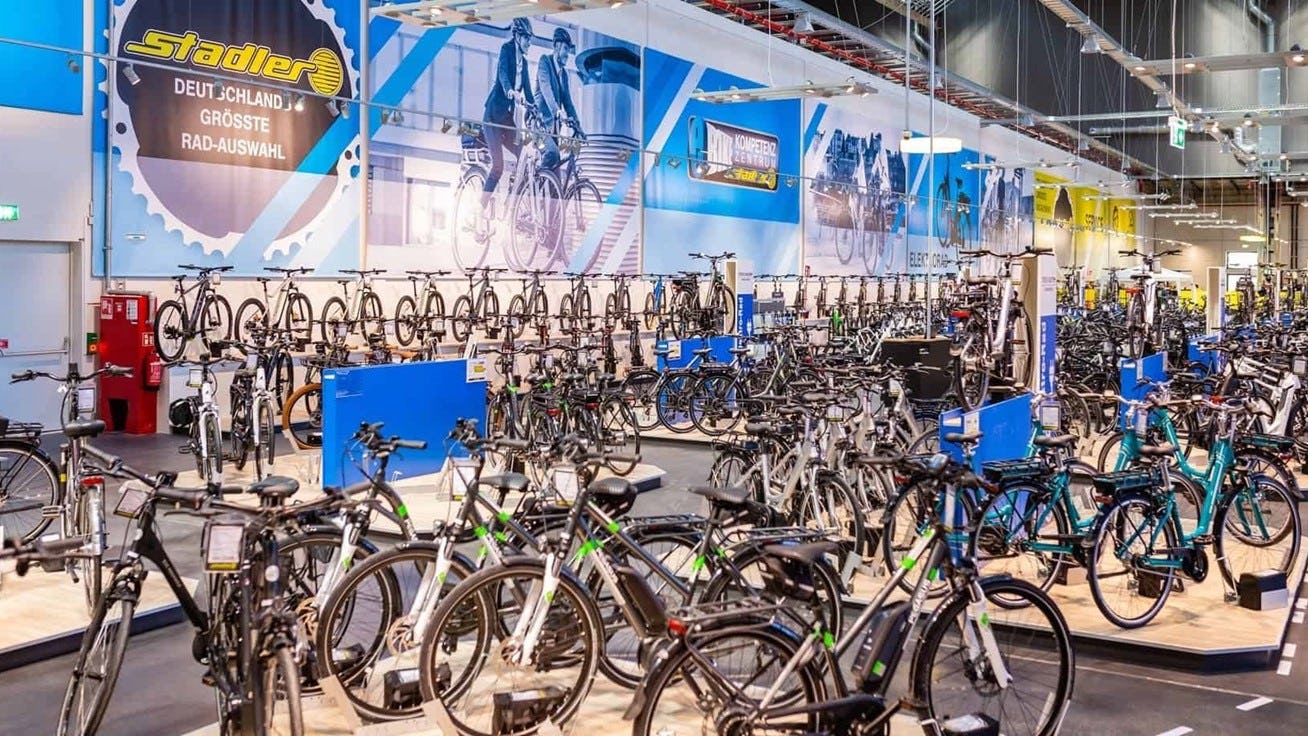
German bicycle market stabilises as e-bike sales reach 2 million units
At two million units, the German e-bike market held steady in 2025, after the volatile market during pandemic years. The sales volume has been around this level since 2023. The same goes for mechanical bicycles, whose sales volume has remained steady over the past three years at just under two million units. To grow the market, the industry should therefore focus on increasing the average retail price, but that continued to decline in 2025. No wonder the industry organisations emphasised the growing popularity of bike leasing and refurbishing at their joint presentation of the 2025 market results.

China back on top as EU's leading e-bike supplier
For the first time since anti-dumping duties were introduced in 2019, China reclaimed its position as the European Union's top e-bike supplier in 2025. The lead is marginal, with an equal 32.8% share of the total e-bike import market together with Taiwan. Although only a mere 350 units more entered the EU from China than Taiwan, the island nation continues to hold 54% share of import value, totalling €318 million.
 Subscribers onlySubscribers only
Subscribers only 7% downturn in bicycle sales in the Netherlands
The total market value in the Netherlands surged by more than 60% in the past 10 years, driven by the rising average retail prices for e-bikes. In 2025, combined bicycle and e-bike sales totalled at €1.533 billion, a 1.3% decline from 2024. Market growth over the past years has masked declining sales volumes. In 2025, the market experienced a further 7% decline in units. At the same time, the average price increase of e-bikes and bicycles combined exceeded the rate of inflation more than twice. To what extent will consumers continue to pay the ever-increasing prices?
 Subscribers onlySubscribers only
Subscribers only Czechia's e-bike market reports lower volumes, but retains optimism
The Czech industry just can't seem to regenerate the local e-MTB market. Czechs are primarily focused on off-road e-bike use, and e-MTB models were a strong segment in 2025, but this category is still threatened and burdened by the ongoing sales crisis since 2023. Still, there are positive signs coming from this important production base for the EU market.
 Subscribers onlySubscribers only
Subscribers only 2025 export data shows depths of Taiwan supply chain struggle
That 2025 was not going to be a good year for the Taiwanese industry was already evident after Taipei Cycle in March when it became obvious that order books were still empty. The bicycle-producing nation closed 2025 with a 7% drop in e-bike export volume, compared to the record-breaking bad year in 2024. With just under 337,000 units leaving the country and the export value dropping another 3%, it shows the Taiwan industry is still facing an uphill climb to bring production back to pre-pandemic levels.

Bangladesh bicycle exports see revival after two years of decline
DHAKA, Bangladesh - The bicycle industry in Bangladesh is quickly recovering from a major slump in exports. In the last fiscal year from 1 July 2024 to 30 June 2025, the export value of bicycles increased by 41% from $83 million (€71.9 million) in 2023/2024 to $117 million (€101.3 million) last year. This data was released recently by the country's Export Promotion Bureau.
 Subscribers onlySubscribers only
Subscribers only Japan clings to hopes of recovery amid continued bicycle sales decline
SHIZUOKA, Japan - The situation for the Japanese bicycle industry becomes even more challenging now that sales and production numbers for 2024 have turned out to be lower again for the consecutive year. For the first time in decades, domestic production fell below the 700,000 unit mark. Import volumes saw single-digit growth, but remained below the 5 million unit mark.