For a skilled builder, truing a wheel is second nature. But feel does not scale: it is hard to reproduce exactly, hard to document, and slow when every wheel starts from zero. Workshops want to deliver consistent, measurable quality without losing the craft that makes a good wheel. “Our new Roce machine family was designed around exactly that tension between craft and consistency,” says Jim Smits, sales manager at Holland Mechanics.
Two machines, one philosophy
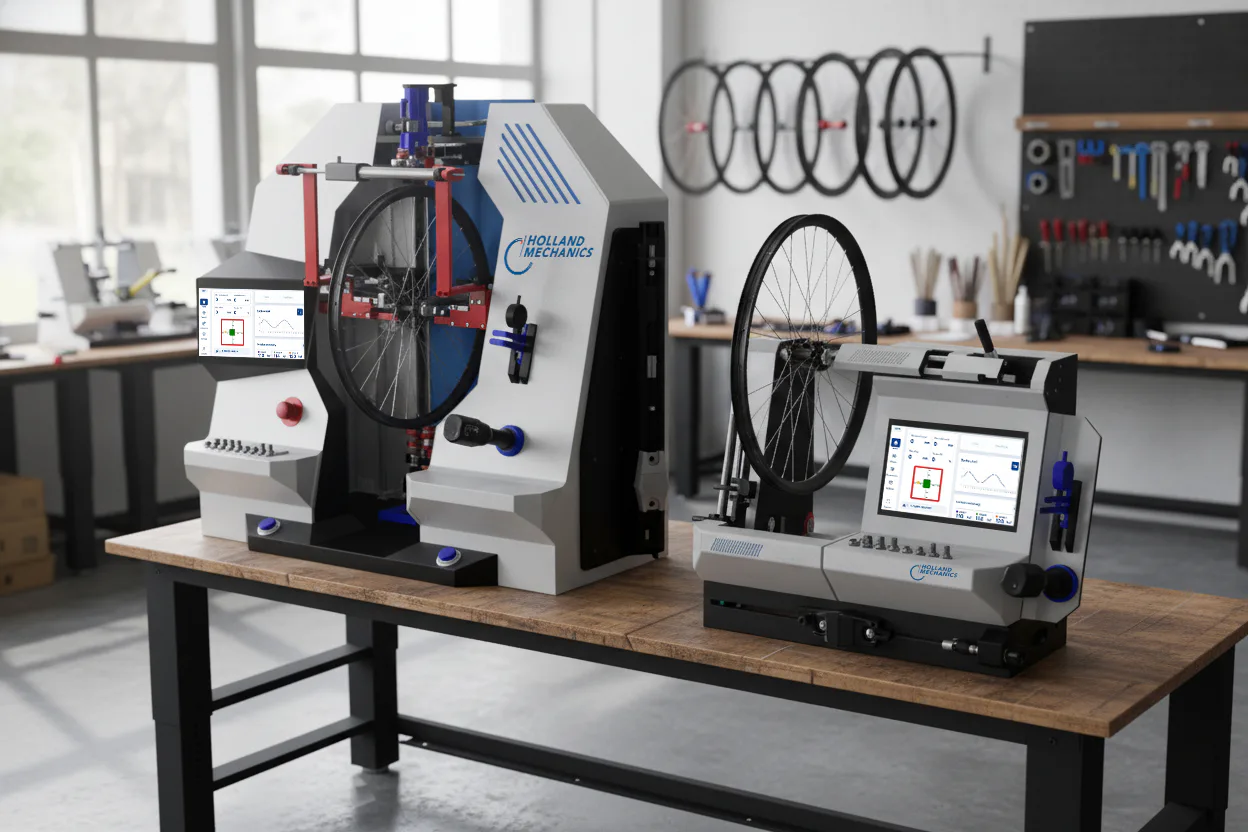
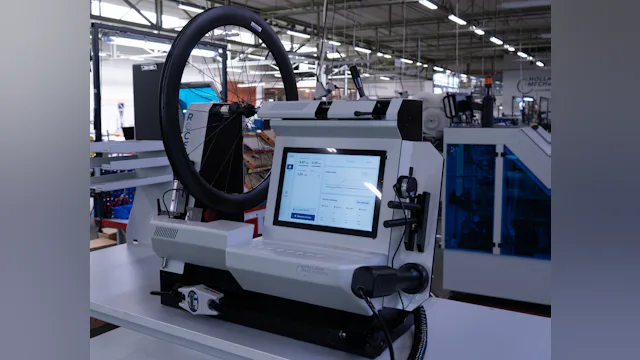
Smits tells us more about the two machines the company developed: “The Roce is available soon and on show at Eurobike. This machine measures directly on the rim, reading radial and lateral runout in real time and guiding the builder through correction on a clear, responsive interface. It suits workshops and smaller lines that want measurement-grade results without changing how they work.”
Our new Roce machine family was designed around the tension between craft and consistency”
“The Roce Pro, arriving early next year, steps up for the highest accuracy,” he continues. “Like every automated truing robot we make, it measures on the hub rather than the rim, enabling centreline truing that keeps the rim correctly centred over the hub instead of merely round. It also adds integrated stressing, settling the spokes as part of the cycle rather than as a separate manual step that means taking the wheel out. The result is a wheel that holds its trueness longer, straight off the machine.”
On both machines the wheel model is created on the machine itself, emphasises Smits. “Nothing external is needed to define a build, set tolerances or run a wheel.”



Tension and trueness in one workflow
Both machines integrate a spoke tension calibration tool directly into the interface. Beyond reading tension, it lets the builder create spoke curves and link them to wheel models, so each build references the exact characteristics of the spokes it is made with. “That matters because spokes of the same model can behave differently from batch to batch, which is why calibrating the actual spokes is always more accurate than relying on generic, cloud-based spoke curves,” Smits explains. “Calibrating per batch and tying that curve to the model keeps tension data accurate to the wheel on the stand, and puts the builder in full control of the result.”
“A wheel is only as good as the data behind it,” continues Smits. “By calibrating the actual spokes on the bench, the builder works with real measured values instead of an average. That is the difference between a wheel that is true today and one that stays true.”
Driving to the exact degree
Precision in measurement only pays off if the correction is just as precise, mentions Smits. “Both machines work with a dedicated powered screwdriver built around a soft-start motor. Rather than snapping to speed, it ramps up smoothly and turns each nipple by the exact number of degrees the machine calculates, then stops cleanly. That soft start prevents the angular distortion and overshoot an abrupt start would introduce, so the spoke ends up at the intended tension on the first pass instead of being chased back and forth.”
A wheel is only as good as the data behind it”
Data that stays with the builder
Here the range takes a deliberate stance: there is no mandatory subscription. Everything needed to build wheels runs on the machine itself. A subscription is offered only as an option, unlocking cloud storage of build data via hmbikecloud.com for those who want their wheel models, tolerances and tension records backed up, shared across sites or analyzed over time. “Useful if wanted, invisible if not,” Smits adds. “For a workshop, it means the machine keeps working regardless of any subscription, and the build data always stays with the builder.”
Faster starting point
Smits concludes: “This really pays off when a Roce machine sits downstream of an automatic truing robot such as the OT. The OT can box-finish wheels on its own, but in high-end wheelbuilding the last 10 percent is often still done by hand. That is where the data flows the other way: the build profile is pushed from hmbikecloud.com down to the Roce, so the builder picks up exactly where the robot left off rather than starting from scratch. The result is less setup, fewer trial passes and significantly faster builds.”
This article is sponsored by Holland Mechanics.